Tuesday, February 20, 2007

The exhibition: Improving life


Several weeks ago, I was at the National Museum of Singapore and I caught the exhibition titled: Improving Life - The Design of Swedish Innovations. The exhibition was held from 12 Jan 2007 to 11 Feb 2007, so if you have missed it, here's snippets of it for your pleasant viewing.

One thing that struck me at the exhibition was how simple, yet effective designs could help make life better for us. An innovation doesn't have to be of a grand scale, but it can neverthless contribute significantly in improving people's lives.

Some innovations become such a part of our lives that we may have taken them for granted. One example is the safety match. Professor Gustaf Erik Pasch patented it in 1844. Prior to the invention of the safety match, matches were made with yellow phosphorus and such matches could be lit simply by striking them against any surface. So what did Professor Pasch do to make the design of the match safe?

According to one of the display panels at the exhibition, Professor Pasch not only replaced the yellow phosphorus with red phosphorus, he also divided the chemical components so that the phosphorus was on the side of the match-box. With this design, the matches could only be lit by striking them against the side of the box. That makes the matches safer. I think it was a simple yet ingenious design.


Safety matches


I realised that designers often have a vision in their mind and that vision often drive them to overcome the odds as they present their designs and innovations to the world.

When I was quite a young child, probably no more than seven years old, I remember that I was playing on one of my uncle's Apple computer and there was no colour except black and green on the monitor. But today, we can clearly see colour on our computer monitor.

Who has brought about this change? As best as I understand from the exhibition, Mr Hakan Lans invented and patented a technique is used in today's computer monitor's color graphic. Back in the mid 1970s when colour television became common in most homes, there was no demand for computers with colour screens yet. But Mr Hakan Lans had the foresight to foresee the need for such a technology. Why do I say designers need vision to overcome the odds? Well, I read that back then, most of the major computer companies did not dare to invest in the colour graphics technology because they consider it a luxury. Thank goodness his design went through. I cannot imagine myself using monitor screens that are monochromatic.


A display panel on Hakan Lans' colour screen graphic for computers.


Look at the bottle below. I think it has a very appealing design. I don't drink, but I would feel an urge to take the bottle and have a closer look at it. Do you? And if you read the display panel just below it, you would agree with me that good design can help consumers choose one product over another similar one.


Absolut Vodka's bottle.


Good designs don't come easy. Some are results of a series of good research and studies. For example, the Baby Bjorn Child's Plate and Spoon designed by Ergonomidesign was developed after a series of studies on the eating habits of children.

Aside from being attractive, the shape of the plate also has a purpose to serve. With such a shape, it is difficult for a child to grab hold of the plate and throw it onto the floor. In addition, the slope of the inner edges öf the plate "allow a child to pick up the food, instead of simply pushing it around in circles" (source: related display panel found at the exhibition).


Here's something I did not know until the exhibition. According to one of the displays panel, it is a proven fact that small children riding in rear facing seats are safer than those in forward facing seats. With such designs, the children can enjoy safer rides.


Good design may be things that cannot be touched, but are concepts that can redefine the way we look at things. I found out that the temperature scale, the Celcius scale, was a concept that came from a Swedish astronomer, Anders Celcius.

I could only end this post by thanking the great minds behind these designs. Thanks for improving our lives.

***
To read more about Swedish innovations, check out:
http://www.sverigeturism.se/smorgasbord/smorgasbord/industry/inventions/
http://www.sweden.se/templates/cs/BasicFactsheet____3127.aspx
http://www.sweden.se/templates/cs/FactSheet____15878.aspx

Sunday, February 18, 2007

The Katong/ Joo Chiat Walk, Part 2

...continuing from The Katong/ Joo Chiat Walk


There were quite a number of interesting buildings that I had came across during the walk of the Katong/ Joo Chiat area. Although these buildings were not featured in the Uniquely Singapore: Katong/ Joo Chiat Walking Guide, it is worth to take some glimpses of them.


Leisurely, I strolled along Tembeling Road while enjoying the temporary peace that the street offered. A yellow-colour building stood out and it was one of the featured places on the Walking Guide.


At 62 Tembeling Road, there is a Chinese temple just beside the yellow-colour building. The temple is known as the Kuan Im Tng Temple. In the Walking Guide, it is stated that the temple was built in 1921. One should not miss looking at the ornate facade of the temple. One should also take a look at the statues of dancing dragons found on the temple's roof ridges.


Kuan Im Tng Temple.


Further down, along 89 - 103 Joo Chiat Place, I was recommended by the Walking Guide to see the architectural masterpiece of the Lotus at Joo Chiat apartments. Here's quoting from the Walking Guide:
The Lotus at Joo Chiat apartments are a fine example of integrating old shophouses with new flats, and were built in the 1930s in the Late Shophouse style.
I like these shophouses way better than those along Koon Seng Road. Perhaps I was drawn to the air of elegance that these shophouses of Lotus at Joo Chiat exuded.


I continued my journey and headed for Masjid Khalid, a mosque located at 130 Joo Chiat Road. As I walked towards the mosque, I noticed that the shops nearby the mosque show a distinct Malay influence in their architectural designs.

Masjid Khalid. Built in 1917, and renovated in 1998, the mosque was originally intended as a place of worship for the Indian Muslims.


Notice that the architecture of the shophouses in the background appear Malay in its influence.


I noticed a shop nearby the mosque, and I could not resist the urge to take a photo of the shop. Even an elderly man sitting nearby the shop was beckoning me to take photograph of the shop. I had a feeling that he had thought I was a tourist from foreign lands. Anyway, the shop looked like a carpentry workshop of some sorts. Somehow, I had a premonition that workshops of such layouts may soon vanish from a society that progresses rapidly, unless the rate of preserving our heritage could catch up.


In addition, my hands could not resist taking a photo of a man washing one of the stairways found at the back of a row of shophouses.


My walk continued as I walked towards Joo Chiat Complex. Somehow, walking towards Joo Chiat Complex jolted my memories. I recalled that my mother had brought me to Joo Chiat area for haircut when I was much younger. No wonder some parts of this part of Singapore looked vaguely familiar to me.


Joo Chiat Complex. This is one place to find Malay textiles and foodstuff.


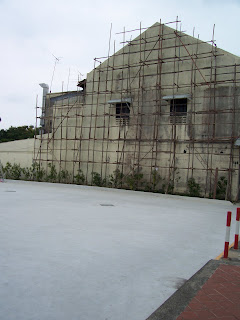
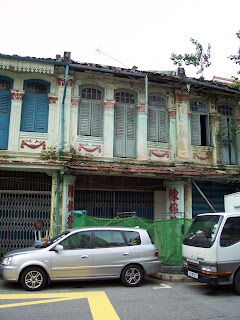
During my walk, I noticed that there were probably some restoration works coming up for some of the shophouses. Would restoration give these shophouses new life, or would it make them lose their nostalgic flavour?


***
Too much of walking can be strenuous so I took a short moment of break before moving on. I was not confident of taking too long a break for if you could tell from the photographs, the skies were already turning very dull by then and I was worried that it might rain anytime then.

After the short moment of rest, I walked along Joo Chiat Road and came close to an open space called Joo Chiat Square. According to http://myjoochiat.com, Joo Chiat Square was launched by Member of Parliament Chan Soo Sen on 23 Dec 2006. "It is an initiative by the Joo Chiat Citizens' Consultative Committee for a planned programme of wholesome family and community activites right in the heart of Joo Chiat." I think Joo Chiat Square would make a fairly good performing ground for the performing arts just that the weather has to be kind or else sheltered tents have to be pitched.


Joo Chia Square.


Joo Chiat Sq.


Joo Chiat Sq.


After imagining the various possibilities that Joo Chiat Square could make as a venue for performing arts, I thought to myself that it would be great if there could be a story-telling programme held right there. There will also be several operas being staged there later the year.

By that time of the afternoon, I have covered quite a bit of the Katong/ Joo Chiat area. I walked towards the direction of Carpmael Road and headed for Ceylon Road. This Katong/ Joo Chiat area continued to treat my eyes to interesting sights and architecture.


I found the dragon-like designs on this building a fairly unusual one.


The skies were turning grey.


When I reached the junction of Ceylon Road and Dunman Road, I was fully aware that the Eurasian Community House stood at one extreme end of Ceylon Road. I decided that due to poor weather forecast, I would not walk towards Eurasian Community House. I merely took a photo of the building from a distance.


Eurasian Community House in the background.


The next part of my journey took me to two places of worship located along Ceylon Road. The St Hilda's Anglican Church at 41 Ceylon Road came across to me as a simple yet dignified-looking church. I was informed by the Walking Guide that the church was built in 1934 and was designed after a simple English parish church style. The conical tower of this church was built in the Victorian tradition.


St Hilda's Anglican Church


Very closeby to the church at 19 Ceylon Road is one of Singapore's oldest Indian temples, Sri Senpaga Vinayagar Temple. This temple has a history that dates back all the way to 1875. Its 21-metre high Rajagopuram makes it one of the tallest Indian temples in Singapore.


Sri Senpaga Vinayagar Temple. Notice the statues of the elephants.


After walking along Ceylong Road, towards East Coast Road, I found myself coming back to where I had started my walk. There was quite a number of things to see along East Coast Road. Certainly, it appeared to me that there are a lot of good eating places along East Coast Road and the Katong/ Joo Chiat area. Please check out these two links for more information: http://myjoochiat.com/food-areas.htm and http://www.goodfood.sg/east.


I like the row of conserved terrace houses along 150 East Coast Road. There is something unusual about these houses. Notice that the living area of these homes is built on raised grounds. These houses actually stand beside a former sea wall near where the beach used to be. I like the unique architecture of these terrace houses which according to the Walking Guide, showed "an eclectic mix of traditional local architecture infused with Western influences, seen in the elaborate fascia boards and decorative plaster motifs."


Conserved Terrace Houses along 150 East Coast Road


My walk that afternoon has been generally a peaceful yet interesting one. I think tourists who come to Singapore should not just visit the regular places like Chinatown or Orchard Road, there are also a lot to see at the Katong/ Joo Chiat area. Even more so, the folks in Singapore who aren't living in the East could visit this part of Singapore to experience the rich and colourful sights that Katong/ Joo Chiat has to offer.


My next stop was the Church of the Holy Family at 6 Chapel Road. This is a pre-World War II parish church and it was a focal point for the Eurasian community of Katong/ Joo Chiat.


Church of the Holy Family


For a piping hot cup of coffee, one can stopped by at Chin Mee Chin Confectionery which according to the Walking Guide, is one of the last remaining Hainanese coffee shops that retains an authentic 1950s ambience. It is located at 204 East Coast Road. I saw that it also sells hot kaya buns and sugar rolls.


Chin Mee Chin ConfectioneryChin Mee Chin Confectionery.


Nearby, at 208 East Coast Road, is the Katong Antique House. Here one can find beautiful Peranakan artefacts. It is certainly a place to shop for things Peranakan. I like its shopfront partly because the walls were painted in my favourite colour, blue.


Katong Antique House.Katong Antique House.


Then I ventured towards the direction of Still Road. At 25 & 26 Still Road South, lies the former Grand Hotel. The Walking Guide gave me some insights to the history of the Grand Hotel:
In 1917, Moona Kader Sultan, a wealthy Indian cattle merchant built the Karikal Mahal or the Grand Hotel as it was later known. Originally a complex of four houses, the luxurious gardens were split into two with the construction of Still Road in 1973.


Former Grand Hotel


former Grand Hotel


After treating my eyes to so many interesting sights, and my feet to a good workout, I was nice to my stomach and palate and treated them to Tau Kwa Pau, a dish consisting of fried beancurd skin stuffed with various ingredients such as minced meat, egg and cucumber. I quite like the special chilli sauce that came with it. Yummy.


My conclusion is that the Katong/ Joo Chiat area is a great place for the senses and the taste buds. The area is also a nice retreat away from the busy city life. Do pick up a copy of the Uniquely Singapore: Katong/ Joo Chiat Walking Guide and explore this part of Singapore too. Travelling in Singapore itself can be fun and enjoyable.


**
References:

Uniquely Singapore: Katong/ Joo Chiat Walking Guide. Published in Mar 2005 by Singapore Tourism Board.
http://myjoochiat.com


***
Some posts or wesites related to Katong/ Joo Chiat area:
Uniquely Singapore: Katong
http://yesterday.sg/detail/rememberingkatong (by June Yong)
http://www.ura.gov.sg/publications/walking_maps/
Uniquely Singapore - The Katong Laksa Wars
http://en.wikipedia.org/wiki/Katong
http://en.wikipedia.org/wiki/Joo_Chiat
http://weluvhistory.blogspot.com
http://www.betelbox.com/about_joochiat.htm
http://syntaxfree.org/blog/archives/000953.php (recommended by Tony)

The Katong/ Joo Chiat Walk


This series of posts is specially dedicated to the thoughtful Eastcoastlife who has so kindly got me a copy of the Uniquely Singapore: Katong/ Joo Chiat Walking Guide when she learnt that I wanted to do a walking tour of the Katong area.

***
On the afternoon 3 Feb 2007, with the helpful walking guide given to me by Eastcoastlife, I started my leisure stroll of the Katong/ Joo Chiat area.

As I was drafting this post, I conducted a search using Google and found a description of Katong, Singapore, on Wikipedia: http://en.wikipedia.org/wiki/Katong

According to the information found on Wikipedia:
Katong is a residential area in the east of Singapore near the seafront. It is a suburb of great prestige and possesses special historical charm for its Asian heritage and seaside town charm.

What about Joo Chiat? It so happens that Wikipedia also has a write-up on Joo Chiat itself and here's a snippet of the write-up:
Joo Chiat is best known for its colourful rows of traditional Peranakan shophouses, dating back to the 1920s and 1930s, that line its narrow streets. The area is named after Chew Joo Chiat, a wealthy landowner, who built shophouses and residential units on land he bought after World War I. In the early days, the colonial government granted land to entrepreneurs.

On the Uniquely Singapore: Katong/ Joo Chiat Walking Guide is a quote by Mr Foo Kee Seng, a long-time Katong resident, and according to the quote:
Actually Joo Chiat is part of Katong...In the old days, no Joo Chiat. Joo Chiat is only a road, not a constituency

It looks like the Katong/ Joo Chiat area has a very rich heritage and history way beyond my current level of comprehension. After my walk, I do agree that there is a special historical and cultural charm that the Katong area possess. I cannot help but take more than a second look at many of the buildings that are standing on the grounds of Katong.

Here, I would like to invite you to join me virtually on this walk of the Katong/ Joo Chiat area, minus the sun and the sweat.


Former Joo Chiat Police Station, now Katong Village.


My tour of the area started from 86 East Coast Road, which was the site of the former Joo Chiat Police Station that was built in 1928. Notice its architectural style, according to the Walking Guide, the style of this building is similar to many government buildings built at that time.

I had the pleasure to have brunch with my two of my friends at Hong Kong Tea House located within Katong Village. Eastcoastlife has a nice post on Hong Kong Tea House which operates 24-hours-round-the-clock for all to check out. As such, I conclude that one can never go hungry when one is at Katong.

While having brunch at Hong Kong Tea House, I found myself attracted to the tall ceilings of the pre-war building. I thought to myself, in those days where there was no air-conditioner, tall ceilings seemed to be good solutions for good ventiliation in the hot, tropical climate of Singapore.


Inside the building at 86 East Coast Road.


When I started on my walk, I looked just across the road of 86 East Coast Road and saw glimpses of the former Red House Bakery. I have heard from many people about the Red House at that part of Singapore but have not been in it before it was closed in 2003. It looks like I have missed experiencing a part of life in Singapore when I was younger.

I've learnt from the Walking Guide that the Katong Bakery & Confectionery that had once operated there was once famous for its Swiss rolls and curry puffs. I've also learnt that the bakery was the first to bake three-tier Western-style wedding cakes in the 1920s. I wondered: How was it like to enjoy the curry puffs in Red House Bakery several decades ago? This place must have hold a special place in the memories of many of the folks who had spent their time there previously. Would anyone onboard like to share with me your memories of this place?


75 East Coast Road, Former Red House Bakery.


Just beside the former Red House Bakery stood a row of stalls that are famous for their Nonya Laska. One can be awfully spoiled for choice of Laksa if one were to be at that part of Katong.


One of the stalls that sells Laksa. Notice the architecture of the building.


As one walks from the row of Laksa-selling stalls towards Joo Chiat Road, one would pass by 113 East Coast Road. Now Rumah Bebe stood there. This location used to be occupied by the Tay Buan Guan shop. From this humble shophouse location, I was told by the Walking Guide that Tay Buan Guan department store grew to a multi-storey shopping centre. If you are at the present Rumah Bebe, do look out for the faint TBG print on its shopfront, which stands for Tay Buan Guan.


Almost just across the road stands Katong Mall. There is a heritage marker right in front of the mall, and it gives a nice introduction to the Katong/ Joo Chiat area.


There were a lot more places in Katong area to be covered. I was already attracted to the idyllic Katong area and its interesting buildings by then.

***
After sipping some water outside Katong Mall to quench my thirst, I continued my walk about the Katong/ Joo Chiat area. My next stop was the Joo Chiat Community Club along 405 Joo Chiat Road.

At the back of mind, I wondered why on Earth the Walking Guide would feature a Community Club. But after reading the guide, it did make sense. The Joo Chiat Community Club used to be just a humble wooden hut with simple facilities, but that wasn't as important as the fact that it continues to be one of the meeting points for the Katong/ Joo Chiat community even after it has been extensively renovated. I suppose I could say that the significance of a place is often measured by how it has served the people of the community?


It took me quite a while before I found my next stop, 341 Joo Chiat Road, the site of the former Joo Chiat Maternal and Child Health Clinic.

The Walking Guide had said that the building is of a prominent red colour. I realised that I was too obsessed with looking out for a red-colour building that I did not even bother to check the number-signs found on most of the buildings in the area. It turned out that the building is now white.

I learnt from the Walking Guide that the former Joo Chiat Maternal and Child Health Clinic was established in 1907 to counter Singapore's high infant mortality rate.


Now, for some treat to the eyes. As I strolled further down the road, I reached two rows of pre-war shophouse along Koon Seng Road. It was quite obvious that the architectural designs of these shophouses are show Peranakan influences. Notice the ornate designs and the fusion of Eastern and Western inflences.


Nearby, at one end of Koon Seng Road, the following building caught my attention. There was no mention of it on the Walking Guide but I took photographs of it nevertheless.


There are more places to visit, so for now, let's take a break to recharge ourselves for more of the Katong/ Joo Chiat area. Do come back for more.

(to be continued...in The Katong/ Joo Chiat Walk, Part 2)


**
References:

Uniquely Singapore: Katong/ Joo Chiat Walking Guide. Published in Mar 2005 by Singapore Tourism Board.
http://en.wikipedia.org/wiki/Katong
http://en.wikipedia.org/wiki/Joo_Chiat

***
Some posts or wesites related to Katong/ Joo Chiat area:
Uniquely Singapore: Katong
http://yesterday.sg/detail/rememberingkatong (by June Yong)
http://www.ura.gov.sg/publications/walking_maps/
Uniquely Singapore - The Katong Laksa Wars
http://myjoochiat.com
http://weluvhistory.blogspot.com
http://www.betelbox.com/about_joochiat.htm
http://syntaxfree.org/blog/archives/000953.php (recommended by Tony)

Wednesday, February 14, 2007

SMRT Bishan Depot

I dedicate this post to HY whom I have promised to share the photos of my visit with.

An SMRT train.


In the year 1987, the first MRT section commences from Toa Payoh to Yio Chu Kang. I could still remember that my mother bought me, my brother, and my grandmother the commemorative tickets so that we could take the MRT train and enjoy the honour to take a ride on the MRT trains when the service had just started.

Back then, none of us knew how it would be like to ride a MRT train. It was a totally new mode of public transport. I could vaguely remember it was a novel experience for myself when I first sat on the MRT train. I recall the sound of the train going "whooosh...", for the train ran faster than the speed of a public bus, which was my main form of transport prior to the start of the SMRT system. I also remember myself taking train rides to and fro Yio Chu Kang and Toa Payoh station a few times that very day with my mother, alighting at each of the train stations simply to see how different each one looked.


The commemorative ticket issued in year 1987 for travel on the first day of operation of the SMRT train system. Thanks to my dear mother who has actually kept this ticket for twenty years!


Twenty years later, the SMRT is celebrating its 20th anniversary. In conjunction with its 20th anniversity, the SMRT Silver Tribute Fund has been set up. If I have understood correctly, the main objectives of the SMRT Silver Tribute Fund are to dignify the lives of the elderly and strengthen the families and communities that care for them. I very much like the concept behind what drives the fund: "They (the elderly) have given us and our nation their best years. Now, let us give them something in return to say Thank You for Everything!."

On 11 Feb 2007, I attended the SMRT Open House at the Bishan Depot, and it was an interesting visit for me. If you would like, please join me as I share about my visit to the Bishan Depot.

The SMRT train system has now become an important part of the lives of commuters in Singapore. I realise that many of the times when I meet my friends, we would often choose our meeting point to be at one of the SMRT train stations. For myself, I take the SMRT train to work everyday. It was hence exciting for me to find out more about the elements behind-the-stage that make the SMRT train system work and serve thousands of commuters in Singapore.

In the morning of 11 Feb 2007, before 10 a.m., I hop onboard one of the SMRT trains from the Ang Mo Kio SMRT train station and got myself a free ride to the Bishan Depot. It was my first time riding a SMRT train to the Bishan Depot and you could probably imagine how fascinating it was for me.


Onboard a train at Ang Mo Kio train station.


Reaching Bishan Depot.


When the train touched the entrance of the Bishan Depot, it took quite a while for the train to travel to the deeper depths of the depot before the passengers could alight at a platform which was nearby where the funfair and the main site of the SMRT Open House.


Inside Bishan Depot.


Alighted at this platform.


It would be difficult for me not to go for the guided tour around the Bishan Depot since that was available on that day. But before that, I went to check out how participants of the SMRT Cram Jam event squeeze themselves onto a SMRT taxi, bus and one of the SMRT cabins.


The squeeze.


Mini Fun Fair.


After much waiting, it was my turn to join one of the guided tours. To start the guided tour, participants were treated to a Corporate video of the SMRT Corporation. Next on the programme was a presentation to a railway stimulation in the Model Railway Room. I love to learn about how things work.


The guided tour also brought us to the Rolling Stock workshop, the department which does train overhaul, i.e. the maintenance and servicing of the parts of the train. Here, I get to see how the various parts of the air-con (evaporator, condenser etc) of a SMRT train look like. The children who were in the same tour group as yours truly looked delighted to see all these parts which are normally concealed from the eyes of the commuters.


A bogie.


And I had the pleasure to walk up a refurbished SMRT train and for the first time in my life, get down the train from its head. I realised that there are some well-informed participants onboard the same tour group that I was in. They asked very good questions.


New appearance after a refurbishment.


This feature allows a Deaf person to be able to know that the train doors are closing.


Doesn't the refurbished train cabin feel wide and spacious?


Afterwhich, the tour took us to the Communications Workshop where we were treated to a demonstration of the SMRT train's public address announcement system. In addition, we get to see how the closed circuit television works. Cool!


The public address announcement system.


See how intrigued the children (and the adults) got when we learnt about how the closed circuit television works.


Next on the programme was a visit to Automatic Fare Collection Workshop. I realised that my eyes were interested to look at the sensors on the faregate. The reason could probably be that for the new faregates, there are more sensors. That means that there is a less likelihood for myself to be caught trapped by the gates.


Notice the small holes. The sensors are hidden behind those holes.


These machines collect the fares.


Finally, the last stop for the tour was at the Training Track. Here, participants of the tour get to see the various types of tracks. Finally, I realised during the tour that the stones on the train tracks that are above ground-level are actually meant for noise reduction.


Tracks found above-ground level.


Underground tracks found commonly under areas highly densed with tall buildings, e.g. Raffles Place. Notice the rubber paddings under the tracks. The rubber paddings can help absorb the vibrations from the moving trains.


Underground tracks, without the rubber paddings. More cost-effective.


If you wonder how a train could change from one lane of the track to another, here's a clue.


One thing that struck me about the tour was the dedication that the various staff who have given the demonstration have demonstrated. I could sense that they serve with a lot of pride and joy. A special thanks to the folks who have made travelling between places to places much convenient for us commuters.

After the tour, I walked about the depot for a while before taking a SMRT train back to the Ang Mo Kio train station. On my way back, I met Pinkie and her children. Such a coincidence.

Whatever it is, I have had an enriching time at the depot even though I didn't join in any of the games at the mini fun-fair. What's more, by joining the guided tour, I have indirectly contributed to the SMRT Silver Tribute Fund.


Note: This post was republished on 15 Feb 2007 with minor editions.

Thursday, February 01, 2007

At the Asian Civilisation Museum: Mystery Men

Mask with Protruding Pupils and Ornamented Forehead.


Foreword: I would like to dedicate this post to my dear friend, Emily, who very much wants to catch this very exhibition that I am going to write about. I hope she can soon find the time to catch this exhibition.

**

Last Sunday, I have made a special trip down to the Asian Civilisation Museum (Singapore) just to catch the exhibition titled Mystery Men: Finds from China's Lost Age.

As a ardent supporter of the museum's guided tours, I would recommend all laymen, like myself, to hop onboard one of the guided tours to this particular exhibition. The guided tour would help lend one a good overview to the exhibits in this exhibition in a duration of about an hour. The schedules of the guided tours to Mystery Men: Finds from China's Lost Age can be found here: http://www.acm.org.sg/visitus/guidedtours.asp)

Prior to attending the guided tour, I decided to check out the exhibition first. I was fairly impressed by the exhibits at the exhibition. I could sense that the curators have put in much thought and care in curating this exhibition.


Shortly later, I joined in one of the guided tours. During the guided tour, I found out from the guide who was leading the guided tour that I was onboard, that it took about four years of behind-the-stage work (from obtaining approval from the authorities in China, to planning, etc) to make this exhibition a reality. When I heard that, I felt thankful to the many people who have worked behind-the-scene. Their efforts have paid off finally.


What is so special about this exhibition? If I try hard to be a history bluff, I shall say that in this exhibition I can get an experience of what early Chinese civilisation could be like. But it was more than that. I read from one of the brochures on this exhibition that a discover made in 1986 challenges the widely accepted view of the Yellow River Basin as the cradle of early Chinese civilisation.

And since anyone would have figured that I am trying hard to be a history bluff, I shall make my life easier by quoting from one of the exhibition's publicity brochures that writes about the discovery that is closely related to this exhibition:

In 1986, brickyard workers in Sichuan made an amazing discovery. They came across a sacrificial pit which was filled with elephant tusks, bronze human heads, ceremonial jades and gold. Fantastic-looking masks – some with protruding pupils, large ears and attachments to the forehead – were excavated and found to have been made some 3,200 years ago. The site known as Sanxingdui was to challenge all previous understanding of early Chinese civilisation. (view source)

While I was at the exhibition, my mind was working very hard to answer the many questions that struck me. What is Sanxingdui? It turns out that Sanxingdui is the name of the location of the two sacrificial pits in which the masks were found. Geographically, Sanxingdui is located about 40 km from Chengdu, the capital of Sichuan province. At the exhibition, one can find out a little more about the people who used to live in ancient Sanxingdui. In short, scholars have agreed that the people of the ancient city of Sanxingdui were of Shu origin.


As best as I remember from the guided tour, the first sacrificial pit that was found was about 100 years earlier than the second sacrificial pit. I found it particularly interesting to learn about the differences in the objects between the two sacrificial pits. In addition, I particularly like reading the analysis on the conclusions that one can draw about the Sanxingdui society from the observed differences.

I very much like the concept of one part of the exhibition whereby the set-up attempted to make one feel as if one was right in one of the two pits. Please refer to the photo right below and visit that part of the exhibition if you were to go to this exhibition.


I also like the charts that show in a nutshell a summary of the items that were found in each of the two pits. I think the charts sum the discovery very well for a laymen like myself.


Interestingly, a number of elephant tusks have been found in both the sacrificial pits. I wondered: Were there elephants living in that part of China in those ancient times? If there were, what kind of climate was Sichuan like in those days? The tour guide made some comments that gave me some clues to the answers to my first question.

I realised that I cannot leave the exhibition without taking a good look at the masks of Sanxingdui. The masks are certainly unique with their protruding eyes. What do the protruding eyes symbolise? According to the description boards found next to the various exhibits, some have speculated that the eyes and ears could symbolise acute sight and hearing. Other scholars consider that the protruding eyes were to represent the rulers descended from one of the Shu king, Cancong.

If one were to be dead observant, one could notice that these masks have holes on them, and these holes appear to be there so that the masks could be hung up. What are these masks used for? That is a mystery for now.


Mask with Protruding Pupils. 12th century BCE.
Excavated from Sanxingdui Pit 2.


Mask. Excavated from Sanxingdui Pit 2.


Mask with Protruding Pupils and Ornamented Forehead.
Excavated from Sanxingdui Pit 2.


Mask. This mask has undergone years of restoration.


Other than the masks, I could not help but also take notice of the bronze heads. I read from the plaques next to one of the exhibits that many Chinese scholars believed that the bronze heads found in the Sanxingdui pits represent shamans or tribal leader. What do you think these bronze heads may represent?


Head with Rear Ornament. Excavated from Sanxingdui Pit 2.


Head with Gold Foil. Excavated from Sanxingdui Pit 2.


The bronze head below that was excavated from Sanxingdui Pit 1 is perhaps one of the more realistic looking heads that was found from the two Sanxingdui pits.


Head. 13th - 12th BCE. Excavated from Sanxingdui Pit 1.


I could have a fascination looking for burnt marks on the exhibits. I was told that many of the objects found from the Sanxingdui pits show signs of being intentionally damaged. Some objects were broken intentionally while others were burnt before being buried. Is burning or breaking the items a way that the people of ancient Sanxingdui pay respect to their gods or ancestors?


Can you spot the burnt marks on this exhibit?


At the exhibition, the tour guide also told us of two of the items found in the Sanxingdui pits which are not being exhibited in the exhibition. The good thing is that the curator has been thoughtful to include photographs of these two items for our viewing pleasure. For your convenience, please click on the two links right here to view photos of these two exhibits: Item 1: 青铜立人像, Item 2:青铜神树.

Birds and trees seem to have an important place to the people of ancient Sanxingdui. Please check out the exhibition to find out more.


Head of a bird.


Bird with high crest.


There is a small section on the bronze casting technology of the Sanxingdui civilisation. I found it a little challenging for myself to fully understand the process in which the bronze works were being casted. It might have been better if there could be a video demonstration of the bronze casting process.

Other than items made from bronze, one can find items made from jade at this very exhibition. One of the exhibition's information boards noted that jade production is a complex process, and "the discovery of jade production in Sanxingdui speaks of a society with an established and highly developed artistry".

Deep in my mind, I am curious to find out what was the lifestyle and general cultural beliefs of those people of ancient Sanxingdui. What had motivated them to bury so many precious items in the ground, for religious, sacrificial purposes?

I found myself fairly keen on the exhibits that portray the kneeling poses of the people of Sanxingdui. It appeared that people from different societal classes kneel in different ways. Make a guess which one of the two kneeling poses found below could be adopted by the aristocrats.


Kneeling Figure with a curled hairdo.


Kneeling figure.


Being interested in the roles that women had played in the ancient Sanxingdui society, I took special interest in the exhibit below. Yet, there wasn't much that I could infer from the exhibit other than the fact that women had existed in that society.


I heard that the people of ancient Sanxingdui would place cowrie shells (which were used as a form of currency in those days) in vessles like the ones below, bury the vessels as sacrifice to the gods. Those folks do seem rich. Maybe they could come up with some cultural practices that could better redistribute their wealth? Anyway, the shells were theirs and it should be up to them to decide what they wish to do with it. I can only imagine that these people of Sanxingdui revered their gods very much that they can give up anything for their gods.


Vessel with a Flaring Mouth. (Zun)


The word Shamanism seemed to stuck on my mind after the end of the guided tour. But folks, if you want to know why, I suggest that you visit this exhibition. For one thing, I am not in anyway knowledgeable in the topic of Shamanism. I can only leave the readers with one photo of a related exhibit that had caught my eye.


Figure with Animal Headdress


What kind of society had lived in Sanxingdui more than three thousand years ago? What kind of worldview did the people in that civilisation have? I have more questions unanswered, and I can only keep my fingers crossed that one day, a scholar who has done extensive research on the Sanxingdui civilisation could fill me.

Meantime, there are more to see at the exhibition, and for a price of $8 per adult, one can save oneself from making a trip all the way to the Sanxingdui Museum in China, and yet still view similar exhibits. What could be more cost-effective?

So here's more information regarding this exhibition:

Mystery Men: Finds from China's Lost Age
16 Jan 2007 - 15 Apr 2007
Asian Civilisation Museum, Special Exhibitions Gallery


Opening hours of the museum:
Mon: 1 pm- 7pm
Tue-Sun: 9am-7pm (to 9pm on Friday)

***
References:
http://www.acm.org.sg/home/home.asp
http://www.acm.org.sg/exhibitions/eventdetail.asp?eventID=153
http://en.wikipedia.org/wiki/Cowrie

***
Recommended related external links to check out:
http://www.china.org.cn/e-sanxingdui
http://en.wikipedia.org/wiki/Sanxingdui
Sanxingdui Museum
Sanxingdui Museum, Chengdu Attractions, Sichuan Travel
http://www.springerlink.com/content/ww55jxhn4pjwux52/
Mystery Men unearthed!


***
Acknowledgements:
Special thanks to Shaun for helping me to obtain the clearance from Asian Civilisation Museum to post the photos of the exhibition. A word of appreciation to Asian Civilisation Museum for granting me the permission to post the photos.

Note: All photos above are taken using non-flash photography.


***
Update: There will be free admission to the Asian Civilisation Museum (inclusive of free admission to the Mystery Men exhibition on 19 Feb 2007. In addition, the museum will extend its opening hours from 18 to 20 Feb 2007. Details can be found here.