Showing posts with label WWII. Show all posts

Monday, May 06, 2013

Jonathan Cooper's talk - Beyond the trenches, wire and hell fire

On a Friday evening on 26 Apr 2013, I had the pleasure to attend a talk by Jonathan Cooper, whom I shall henceforth address as Jon Cooper. This talk, Beyond the trenches, wire and hell fire, focused on the Adam Park estate which was the site of an intense phase of the battle for Singapore in the year 1942. Subsequently, Adam Park also served as a POW camp during the Second World War.

During the talk, Jon Cooper fascinated the members of the audience by taking us into stories in the past. He spoke of the building of the Shinto Shrine, the Adam Park Project, the Sime Road Camp and Bukit Brown.

During the talk, Jon Cooper showed us maps of missing soldiers whose bodies have not been recovered yet even though it has been more than 70 years since the battle for Singapore. From a glimpse of the map, some of them were last seen or reported to have been found dead at locations which appear to be present-day Adam Road, Bukit Brown Cemetery and perhaps near Sime Road. The positions of the killed and missing soldiers from the 4th Battalion Suffolk Regiment were based on the six-figure map grid references found in the recently discovered Bureau of Records and Enquiry (BRE) archives.  I was pretty intrigued by the existence of the Bureau of Records and Enquiry.Will the remains of these missing soldiers be found eventually?

Image: Mok Ly Yng.

After the talk, one of my friends, Mok, got in touch with Jon Cooper regarding the information of the missing soldiers. The information from the records suggests that the last known positions of a few of the missing soldiers from the 4th Battalion Suffolk Regiment are in the positions whereby a part of the proposed highway cutting across the Bukit Brown Cemetery would be built. Based on the records (Ref: WO 361/2125), the names of some of these soldiers whose bodies have yet been recovered are:

  • Corporal David Angus Adcock (22), Fate: Missing. 
  • Private Harry Thomas Cattermole (24), Fate: Missing. 
  • Private P Sawyer (no age), Fate: Died at Singapore. 
  • Lance Corporal Cecil George Meadows (26),  Fate: Killed. 

With Mok's help, courtesy of Jon Cooper, I learnt that the information of war dead could be found from the Commonwealth War Graves Commission's website and database. The information regarding the nominal roll of 4th Battalion Suffolk Regiment from 1 Jan 1942 - 31 Dec 1943 could be found under Reference WO 361/2125 of The National Archives. I felt curious why the bodies half of the known "killed in action" soldiers were recovered but the other half have yet been recovered even 70 years later. What had actually happened to the soldiers whose bodies have yet been recovered? I was reminded of how impersonal war can be. May peace prevail.

The intersection of Sime Road and Adam Road.
I was reminded how much history exists at this intersection.
This intersection was referred to as the "Hellfire Corner" due to the amount of Japanese artillery fire this intersection attracted.


During the talk, Jon Cooper also mentioned about previous residents of the Adam Park and how he had found out more about them with the help of the digitalised newsprint library offered by the National Library Board.

Jon Cooper spoke about his hopes to identify the exact location of what had used to be the Adam Park Chapel and more about the Adam Park Project. Anyone who is interested to support or volunteer for the Adam Park Project can find more information on it below:

The Adam Park Project

Overall, it was an enriching talk. Many thanks to Jon Cooper and the organisers for the talk at the Asian Civilisations Museum.

***
Speaker: Jonathan Cooper
Date: 26 Apr 2013 (Fri)
Time: 7.00 p.m.
Ngee Ann Auditorium, ACM Empress Place

Wednesday, October 03, 2012

Yet another Changi Museum War Trail: End of Empire

Kranji Memorials. Designed by Colin St. Clair Oakes.
This year happens to be the 70th anniversary of the fall of Singapore. I was so enticed with the idea of commemorating this special anniversary that I went for a tour by The Original Singapore Walks on 12 Sep 2012. My visit turned out to fall on the 67th anniversary of the Japanese surrender ceremony that was held at the Municipal Building of Singapore (now known as the City Hall).

Read more about my visit here please:
Yet another Changi Museum War Trail: End of Empire

Monday, June 18, 2012

A perfect choice: Battlefield Tour at Cemetery Hill


Life often presents us with many choices to make. One day when I was browsing a.t. Bukit Brown, I came across a special Battlefield Tour at "Cemetery Hill" led by battlefield archaeologist, Jon Cooper. Bukit Brown Cemetery was known as "Cemetery Hill" 70 years ago. The tour was scheduled to start at 10 a.m. on 17 Jun 2012 (Sun). Being intrigued to learn more about the fall of Singapore, the tour immediately caught my interest.

Then, I had a dilemma. I had agreed to meet one of my friends for a cycling trip at Pulau Ubin that very same day. Yet there was no way I can split myself up to be physically at two places at any one time. So I was feeling very grateful when the friend of mine agreed to my counter-proposal to go for the Battlefield Tour at Cemetery Hill instead. This proved to be a perfect choice for the day.

Battlefield archaeologist, Jon Cooper kept the participants intrigued with his passionate rendition and sharing of a rather unheard part of Singapore's history. Jon Cooper started the tour with a self-introduction of himself which gave all of us an idea how he ended up in Singapore when his hometown is in Scotland. I learnt that a few years ago, Jon Cooper came across a heritage marker along Adam Road, and that spun off the Adam Park Project. The project explores the defence of the Adam Park Estate by the 1st Battalion of the Cambridgeshires Regiment from the 12th to 15th Feb 1942 and a lot more.


The Battlefield Tour at Cemetery Hill began on an overhead bridge which looks out to a junction where Sime Road and Lornie Road meet. I vaguely recalled that the intersection of Adam Road, Sime Road and Lornie Road was referred to by British troops as "Hellfire Corner" due to the amount of Japanese artillery fire these intersections attracted.

Our guide, Jon Cooper, shared fascinating stories of the battle that was fought on the few days before the fall of Singapore in 1942. The tour led us to Sime Road, to a spot which used to be part of the Royal Singapore Golf Club, to a forested area near MacRitchie Reservoir and finally to what was known as Cemetery Hill. During the tour, Jon Cooper also retraced the advance of the Japanese tank unit and the retreat of the British soldiers. The exciting part was having to find our way through the bushes to locate what were likely to be defensive positions used during the battle.

This area was previously a part of the Royal Singapore Golf Club.


I was left with an impression was that it was quite a fierce battle that was fought seventy years ago. It was definitely not easy to fight a battle in a cemetery since it was not a terrain that most infantry soldiers would be familiar with.

During the tour, co-guide, Claire, shared with tour participants interesting features of Oon Chim Neo's grave in Seh Ong Cemetery, which is believed to be the largest single tomb in the area. I learnt about the interesting geomancy (fengshui) elements such as the dragon claws, tiger paws and more!


Jon Cooper's sharing of how the British soldiers would have tried to build defensive positions when they were fighting the battle within the compounds of the cemetery led me to infer that the soldiers were likely to be very determined to fight till the very end. It would not be an easy battle to fight in a very unfamiliar terrain and a certain level of determination and courage would be necessary.

The tour concluded at a site where a Chinese temple used to stand. How did the Chinese temple have any relevance to that very battle that happened 70 years ago? It turned out that the Chinese temple was one of the few landmarks that can be visible in the dark hours of those days.

Imagine a Chinese temple in the middle of the photo.

From the Battlefield Tour at Cemetery Hill, I have learnt a lot about a part of Singapore's history that was new to me. It was a perfect choice to spend a Sunday morning learning about history and be away from the life in the city.

Many thanks to Jon Cooper for the invaluable work that he has done to unearth a glimpse Singapore's wartime history with the rest of The Adam Park Project team. Hopefully there would be resources for further research and survey work to be carried out.

Now, here is a piece of good news for the people who have missed the 17 Jun 2012 Battlefield Tour of Cemetery Hill: Due to overwhelming demand, there will be a repeat tour in July! Please watch this website for more details: http://bukitbrown.com

***
Please also see: 
Battlefield Tour (Father's Day special)
Missing Amongst the Dead
The Adam Park Project
Four Days in February: Adam Park the Last Battle (exhibition till 24 Jun 2012)
Ho Siak Kuan (Bukit Brown)
My Great Grandfather was a War Hero


Monday, November 16, 2009

Back to the time of WWII Singapore


I went for the bus tour entitled War on Wheels, Invasion Singapore! during the weekend. This event gets its participants to discover more about Singapore's World War II history.

It was worth the effort to be out early in the morning on a weekend. The bus tour brought the tour group to several important sites to better appreciate the significant events that had taken place when Singapore was invaded by the Japanese military in 1942. It also gave us a glimpse of the civilians' experience of the Japanese occupation and the end of the occupation.

What I particular like was how the tour guide invited the participants to imagine that we were back in time. On the bus, the tour guide shared anecdotes to help the participants to imagine how it was like during the years 1942 - 1945.


So when the bus brought us participants to the Kranji park which used to be mangrove swamps back in Feb 1942, it was not too difficult to imagine that on 8 Feb 1942, soldiers from the Japanese military had advanced across the Straits of Johor and landed on the main island of Singapore using make-shift boats etc. I realised that the Straits of Johor was a comparatively shallow and narrow body of water. Furthermore, the tides at the Kranji landing sites weren't very strong. What this meant for me was that even when the Causeway was destroyed back then, it was not too much a great challenge for the Japanese to attack and land on Singapore once they have reached the southern tip of the then-Malaya.

If I were a military historian, I think there would be a lot of learning points just by reading the strategies that the British had used to defend Singapore, and the strategies that the Japanese had used to attack Singapore more than six decades ago. At the very least I have learnt from this part of history that one should never underestimate one's enemies when planning one's strategies.


The second stop was the Kranji War Memorial. The memorial was built and maintained by the Commonwealth War Graves Commission. "The Kranji War Memorial commemorates the contributions of 24,000 soldiers of the allied forces who died during World War II" (source: http://infopedia.nl.sg/articles/SIP_183_2004-12-27.html). Participants were invited to a simple activity as an act of remembrance to those who have laid their lives during the war. I shall not attempt to reveal much about the activity here since I figured that some may decide to attend this tour during one of the next two Saturdays. 

Having a memorial built for those who have died during the war may bring some comfort to their loved ones and off-springs. On the other hand, the rows of graves and names on the memorial walls reminded me of one thing: War itself has neither eyes nor compassion, even if countless were to die in the name of war.

I wish for peace to prevail.


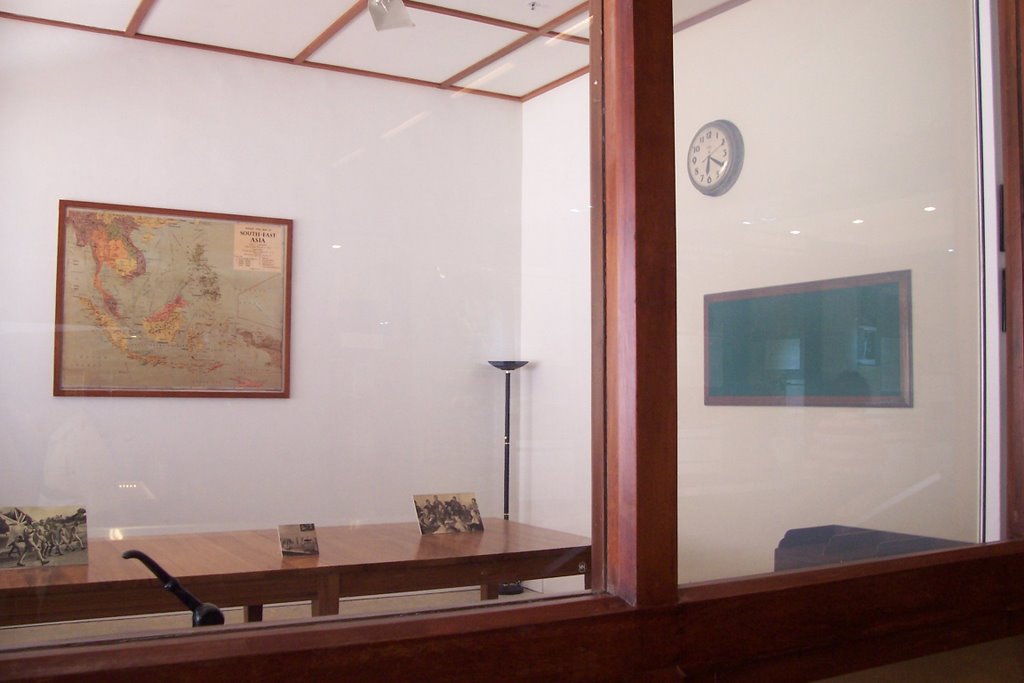
The boardroom. In this boardroom, the British surrendered Singapore to the Japanese on 15 Feb 1942.


The third stop was the Memories at Old Ford Factory. This was where the British had surrendered Singapore to the Japanese. As the bus tour was meant to be a sampler of the various key sites, the participants only had about 15 minutes at the museum. Nevertheless, I had a glimpse of the chamber where the surrender had taken place, and I had some time to read about what had taken place during the surrender. The process that had taken place during the surrender just seemed like a psychological game to me.

At the Memories at Old Ford Factory, there were two short activities that the participants were invited to take part in. During the tour, we also got to see a real "banana money", the official currency that was used during the Japanese Occupation. Well, it reminded me that there are many things that money cannot buy.

Following the stop at the Memories at Old Ford Factory, the bus brought us for a short ride of Alexandra Hospital. This hospital used to serve as a military hospital. On 14 Feb 1942, what I see as a series of atrocious war crimes had taken place here.


Reflections at Bukit Chandu.


After lunch, the bus brought participants to the Reflections at Bukit Chandu. Here, participants learnt about the bravery of the Malay Regiment. I have visited this museum for several times and I can't help but feel a deep sense of respect for the soldiers of the Malay Regiment who have put up their very best to fight a good battle.


Photo taken at Surrender Chambers of Fort Siloso, Sentosa. The actual surrender took place at City Hall.


The tour concluded at City Hall. It was at City Hall, the then Municipal Building of Singapore, where the surrender of the Japanese had taken place. I was imagining that even when everyone cheered for the end of the war, life for people in Singapore would not be quite the same after a war. Nevertheless, the end of the war definitely called for a celebration.

If you should find my short write-up about this bus tour to be interesting, you may wish to know that you can register for this event War on Wheels by visiting SISTIC. There will be bus tours on 21 and 28 Nov 2009 (Saturdays). Please see this site for more information:  http://www.museums.com.sg/es09/war-on-wheels.html