Showing posts with label Tanjong Pagar Railway Station. Show all posts

Sunday, September 09, 2012

Heritage Connects at Tanjong Pagar Railway Station

A chance to ride on vintage scooters.

This is a piece of news for anyone who is interested in a motoring heritage exhibition this weekend. On 8 and 9 Sep 2012, from 10 a.m. - 6 p.m., find your way to the Tanjong Pagar Railway Station. Admission is free.

For more information, please visit this recent blog that I have written:
Heritage Connects at Tanjong Pagar Railway Station

Tuesday, March 20, 2012

Eastern and Oriental Express

This post is overdue.
Then again, memories stay in our minds.
So what was yesterday's memories
Could seem very present
As if these have taken place today.

****
5 Jun 2011 shall be remembered as the date of the final departure of the luxury Eastern and Oriental Express train service from the Tanjong Pagar Railway Station.

On a rainy and tearful day, many people visited the Tanjong Pagar Railway Station to have a good glimpse of the final departure of the beautifully romantic Eastern and Oriental Express from the Art-Deco style Tanjong Pagar Railway Station. This railway station is no longer in operation after 30 Jun 2011.


Thanks to a lift from Jerome, after the Eastern and Oriental Express had departed, there was enough time to witness the Eastern and Oriental Express train travelling past the Bukit Timah Station which is no longer in operation.

Jerome has written a very nostalgic blog-post on this final departure of the Eastern and Oriental Express from the Tanjong Pagar Railway station. Please find his post here: Amidst the rising tide, a tearful farewell to Romance.


That day was a rainy and melancholic day. Perhaps the rain was shedding the tears of sadness to bid farewell to the last Eastern and Oriental Express train that had departed from the Tanjong Pagar Railway Station?

***
Please also read:
Amidst the rising tide, a tearful farewell to Romance.

Tuesday, June 07, 2011

Railway memories

7 Jun 2011

Dear great-great-great-grandchildren,

Today, I have this urge to write to all of you about my excursions to the Bukit Timah Railway Station and various parts along the KTM railway tracks on 4 Jun 2011. I do not know if you would ever experience these places like I did?

At about 8 a.m. on 4 Jun 2011, I reached the Bukit Timah Railway Station with Bel, Za and Ade.
It was my first visit to that railway station. I was pleasantly delighted to find a stretch of green land in Singapore.

Did you notice that Singapore was spelt "Singapura" on this sign?

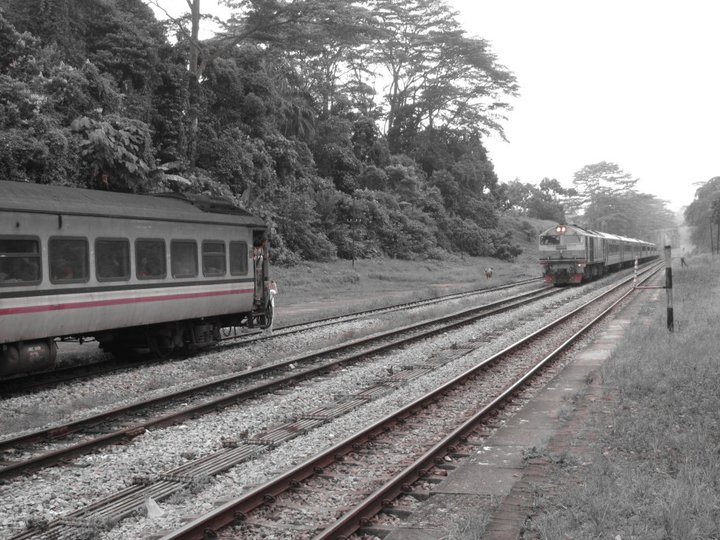
I was more surprised when I saw passengers from the train being given permission to get down from the train. Some of them started walking about the tracks. I later learnt that this very train was stopping at Bukit Timah Railway for an hour to give two other trains the priority to pass.

The railway system works on a one-track system. To prevent the collisions of train along the track, the trains have to exchange key tokens with the station master at Bukit Timah Railway Station to be given the right to move to the next section of the track.
The station will cease operation by 1 July 2011.

Many of the passengers have had fun posing with the train.
Patience pays.
After much waiting, there was a train heading North that was approaching the station.

The station master held a green colour flag in one of his hands and waved it. This waving of the green colour flag served as a signal for the approaching train to move forward.

Do you notice that the train master in the foreground has a ring-like item in his left hand? That is a key token.

After a key-token exchange took place, one of the staff members of the Railway Station was found in the signal room changing the signals.

Soon enough, yet another train approached the station, and in a blinking of the eye, the exchange of key-token took place. I'm sorry that I was not fast enough to capture the exchange of the key-token for you.

This was taken at the waiting area of the station. I shall leave it to you to read your history books to figure out why this station is at this time under the care of the government of Malaysia.

Subsequently, the team and I walked towards the direction of the Rifle Range Road. A kind and helpful gentleman, Jerome Lim, prepared a map with clear suggestions on it for us. Thanks a lot for his help, we were able to find our way along the railway track safely, without losing our way. 

This was taken near King Albert Park. When I was younger, I used to pass by the sign "Malayan Railway Bukit Timah Railway Station" on my bus rides to the National University of Singapore almost every weekday. I did not know that the sign was pointing to a treasure trove of rustic charm until 4 Jun 2011!

Are you feeling excited to see this Truss Bridge that spans across Dunearn Road and Bukit Timah Road?
I hope it is still in existence in your time?

Morning glories.

This was taken along the Rifle Range Road. I love listening to the sounds of Nature throughout the excursion.


Nature, I realised, is more precious than gold. Then again, the values of the decision-makers and the people do play a bigger role in deciding what is of greater value.

There was a rain that day. After the rain, we ventured nearby this Truss Bridge that was near the Railway Mall.
We were very cautious. Other than making sure we know the train schedules well, we had to be mindful to be at least three metres away from the railway tracks at all times.
You see, the trains move very rapidly and it was almost impossible to hear or see an approaching train because of the noisy road traffic and a nearby bend of the railway track.

Thanks to Belinda, I have learnt to take a nice photograph of this butterfly to share with all of you.

We travelled to Choa Chu Kang Road where there was a wide level crossing. We waited more than two hours to see a train passing by the level crossing.

Near the level crossing along Choa Chu Kang Road.

My reward for being patient was this photograph of an approaching train that will soon travelling pass the level  crossing across Choa Chu Kang Road. We asked for and obtained permission to witness the train passing by.

And the train was on its way to the north.

As you read this letter, you could have been very aware that your great-great-great grandmother has never been a train enthusiast. I enjoyed the train rides that I had taken across parts of Scotland when I was there for a short trip in my mid-twenties. The reason that the train rides were so special across Scotland were the scenic views of the countryside.

However, for many years, I could not imagine myself taking a train ride across Singapore, from the south to the north and then up to Malaysia. Would it be simply concrete and magnificent buildings that I would see along the way?


Thankfully, this was a misconception of mine. After reading articles written by Jerome Lim of the blog entitled The Long and Winding Road and after visiting various parts of the railway line in Singapore (from the Bukit Timah Railway Station to Choa Chu Kang Road), I felt grateful that somehow, in this country of mine, I could still have a chance to enjoy a glimpse of the charming rural landscape stretching for miles. I thought that the people who have made this possible have a deep sense of wisdom and respect for the land, whether or not they know what they are doing.

Hillview area. Behind the Standard Chartered Bank.

By the time you read this letter, I would have been long gone from the face of this Earth. I now wonder, if you could tell your predecessors what you hope we could preserve for you today, so that you could experience them decades later, what would you have ask for?


In the distant past, people had built grand cathedrals not because they could ever use them. They had built them for the benefit of their future generations. I hope I could play my humble part to shape the better world that all of you will be living in. I am only one voice. Then again, I could be part of a larger collective.

In land-scarce Singapore, my dearest great-great-great-grandchildren, would you have wished that your predecessors had removed a stretch of railway track to build modern buildings and housing in the name of progress, or had preserved a humble stretch of scenic railway track so that you could somehow reminisce how much Singapore has progressed while maintaining a deep connection with its past and a respect for Nature?

Bukit Timah Railway Station.

Maybe you may just think I am simply sharing some old great-great-great-grandmother's stories. Yet, I wish to understand you and your dreams. What would you hope that we could do right now so that we could lay the foundations that are necessary to benefit you and your great-great-great-grandchildren?

The hibiscus that I saw along the railway track, nurtured by a pair of caring hands.

Before I end this letter, I gave my support by liking the Green Corridor's Facebook page, and hope that this will make a little difference.


With love,
Your great-great-great-grandmother.

Saturday, May 21, 2011

The Tanjong Pagar Railway Station Tour on 21 May 2011

Tanjong Pagar Railway Station.
Photo credit: Belinda Tan.
Being a regular reader of Yesterday.sg and a fan of I Love Museum Facebook page has its special privileges and perks.

Even when all of the weekend special tours of the Tanjong Pagar Railway Station conducted by the Preservation of Monuments Board have been fully booked, lucky readers of Yesterday.sg and Facebook fans of I Love Museum could still secure very special places in one of the  Tanjong Pagar Railway Station Tour led by guides from Preservation of Monuments Board on a Saturday morning of 21 May 2011. The railway station will cease operations by 1 Jul 2011.


Located along Keppel Road, the Tanjong Pagar Railway Station was opened in 1932. During the tour, we learnt about why the location was chosen to be the site of the railway station. The location was specially chosen to best realize the British Empire's vision of creating an extensive transport network across land and sea in this part of the region.


The tour also gave us a glimpse of the history of the railway transport system in Singapore. I learnt about the previous existence of the Tank Road railway station. This railway station was closed permanently on the same date that the railway station along Keppel Road, i.e. the present-day Tanjong Pagar Railway Station, was opened. Our guide for the day also told us about the Singapore Railway Transfer Ordinance of 25 Oct 1918 which authorised the sale of the Singapore railway and the associated land to the Federation of Malaya.


The architecture of the railway station captured my interest most of all. I learnt that the station's architectural style was influenced by Finland's Helsinki Station, and by the Art Deco style. The geometric and angular forms that are found at various parts of the railway station's design are characteristics of the Art Deco style. Our guide told us that the eight-pointed star design that we saw on the ceiling near the entrance of the station represents harmony and balance. This station was designed by Swan and MacLaren, the architectural firm which also designed the Raffles Hotel, the Victoria Memorial Hall and present-day Goodwood Park Hotel.

Did you notice the Oriental influences that can be seen  in this building?
The clue: Look at the green tiled roof.


Of worthy notice are the four towering statues found at the entrance to the station. These statues were to represent the four economic pillars of Malaya: Agriculture, Commerce, Transport and Industry. These are works by Rudolfo Nolli, a Italian sculptor and architect. If any one asked what the initials "FMSR" stands for, the answer is the Federated Malay States Railway.


Mosaic mural panel depicting rubber tapping activities.

During my previous visit to the Tanjong Pagar Railway Station, I did not take sufficient notice of the mosaic inside the station (I was attracted to the high ceiling of the lobby instead). I was glad that our guide highlighted to our attention the mosaic panels in the main lobby of the station during our tour. These six groups of mosaic panels portray six of Malayan's core economic activities. If I had remembered correctly, these were tin-mining, rice-planting, rubber tapping, maritime trade, coconut-planting and agriculture. The mosaic tiles, I later learnt, were made of coloured rubber through a patented process created by the Singapore Rubber Works. Throughout the tour, I did my best to imagine how the railway station would look like in its former days of glory.

Ticketing counter and the lobby.

One of my fellow tour-mates highlighted to me that the ticketing counter is made of solid teak that is now painted white.


The departure platform.

The tour concluded at the departure platform. Members of the tour-group had the special permission to walk along the departure platform which was only accessible to ticket-holders on a regular day. We learnt that the Tanjong Pagar Railway Station is the only station along the Malayan Railway which has hydraulic buffer-stops. The buffer-stops were designed by Ransomes and Rapier.

One of the buffer-stops.

After the tour, another tour mate reminded me that the there was a Station Hotel that used to operate at the Tanjong Pagar Railway Station. Perhaps it would be wonderful if the tour could bring its participants to parts of the previous Station Hotel and let us imagine what a luxurious lifestyle it would have been to have stayed in one of those rooms in the previous Station Hotel. This would have made the tour a perfect introduction to the significance of the Tanjong Pagar Railway Station.

Did you notice the sign that prints "Singapura"?


After the tour, a few of my tour member and I continued to explore the Tanjong Pagar Railway Station and its nearby vicinity.

People chilling out at the food outlets at Tanjong Pagar Railway Station.

My words of appreciation to Yesterday.sg, I Love Museum and the Preservation of Monuments Board for the invitation to the tour. The tour has deepened my knowledge and appreciation of the Tanjong Pagar Railway Station.


Before I end this post, here is to point you to a blog of Mr Jerome Lim's insightful collection of his memories of the Tanjong Pagar Railway Station and his journeys made from that station: http://thelongnwindingroad.wordpress.com/journeys-through-tanjong-pagar/ and here's an update to read his post on this tour: A final look at Tanjong Pagar Station.


To register for one of the remaining special tours of the Tanjong Pagar Railway Station conducted by the Preservation of Monuments Board, please visit: http://www.pmb.sg/?page_id=1183.


References:
http://infopedia.nl.sg/articles/SIP_954_2005-01-10.html
http://searail.mymalaya.com/Singapore/SRhistory.htm
http://searail.mymalaya.com/Singapore/tankroad.htm
http://www.malayarailway.com/2009/07/tanjong-pagar-railway-station.html
http://en.wikipedia.org/wiki/Tanjong_Pagar_railway_station
http://en.wikipedia.org/wiki/Malaysia-Singapore_Points_of_Agreement_of_1990
http://www.pmb.sg/?page_id=1183

Related posts by other writers:
A final look at Tanjong Pagar Station
Trip to Tanjong Pagar Railway Station on Saturday, 21 May 2011
Journeys through Tanjong Pagar

Update (17 Aug 2011):
Please watch a YouTube video recording of the tour on Heritage TV - Tanjong Pagar Railway Station.