Wednesday, January 09, 2013

News: Celebrating Bukit Brown Rediscovering the Past

Source: http://www.substation.org/celebrating-bukit-brown/#more-11016

Dear friends and readers of this blog,


Celebrating Bukit Brown
By The Singapore Heritage Society and All Things Bukit Brown
Sunday 20 January 2013, 2pm – 8pm
The Substation Theatre
Admission: Free of charge


You may wish to take note of this above-mentioned upcoming event. The event is organized by the Singapore Heritage Society and All Things Bukit Brown, with the support from The Substation. If you would like to extend your contributions, you can also contact the Singapore Heritage Society to volunteer your service at this event.

Highlights of the event include:
1. Talks by battlefield archaeologist Jon Cooper on WWII
2. Presentation on the material culture of Bukit Brown and the Chinese diaspora by Dr Lai Chee Kien
3. First public-screening of the documentary Bukit Brown Voices by Khoo Su-Mae and Brian McDairmant. This 45-minute documentary follows Singaporean families asthey carry out Qingming rituals and exhume their ancestors.
4. Update on the documentation project by Dr Hui Yew-Foong, with input from Dr Terence Heng and Jasmine Ng.
5. A public forum.

For more information, please visit:
http://www.substation.org/celebrating-bukit-brown/#more-11016 
http://bukitbrown.com

Sunday, January 06, 2013

OH! Open House 2013: What's our Happiness Index?

OH! Open House 2013. Brochures and tickets.

OH! Open House is back again. This year, OH! Open House takes us to the private spaces in the district of Marina Bay to view works of art. The theme of this year's OH! Open House is The Happiness Index. I am still trying to appreciate how one could possibly explore the theme of Happiness Index in a seemingly corporate and highly structured district of Marina Bay which is Singapore's newest financial district.

This year marks the third year that I have attended OH! Open House. The curiosity to take a peep into private spaces which would otherwise be out-of-bounds to us had prompted me to take an interest in attending OH! Open House. What had sustained my interest in OH! Open House was the privilege to view and experience works of art that were usually created for the private spaces that were provided.

If you are curious, join me for a quick overview of this year's OH! Open House from my personal perspective.

It was my first time visiting the Marina Bay Financial Centre. The financial district of Marina Bay is very new to yours truly who does not work in the financial section. Finding my way there required a bit of simple searching. Perhaps the journey to happiness requires some searching too?

How I have found my way to Marina Bay Financial Centre, Tower 3
I took a SMRT train to Raffles Place MRT station. Then I followed the directional signs and travelled underground to head towards the Marina Bay Financial Centre Tower 3. On my way, I would pass through the Marina Bay Link Mall.

After the Din Tai Fung restaurant at Marina Bay Link Mall, there is a concierge to ask for directions for folks like myself who prefer to receive guidance from human beings. Otherwise, the directional signs are clear enough to lead visitors to the Marina Bay Financial Centre. At Tower 3 of the Marina Bay Financial Centre, there are clear signs to confirm that we are at the right place. By the way, visitors who are hungry would be pleased to find a food-court that serves food at Marina Bay Financial Centre, Tower 3, Level 2.


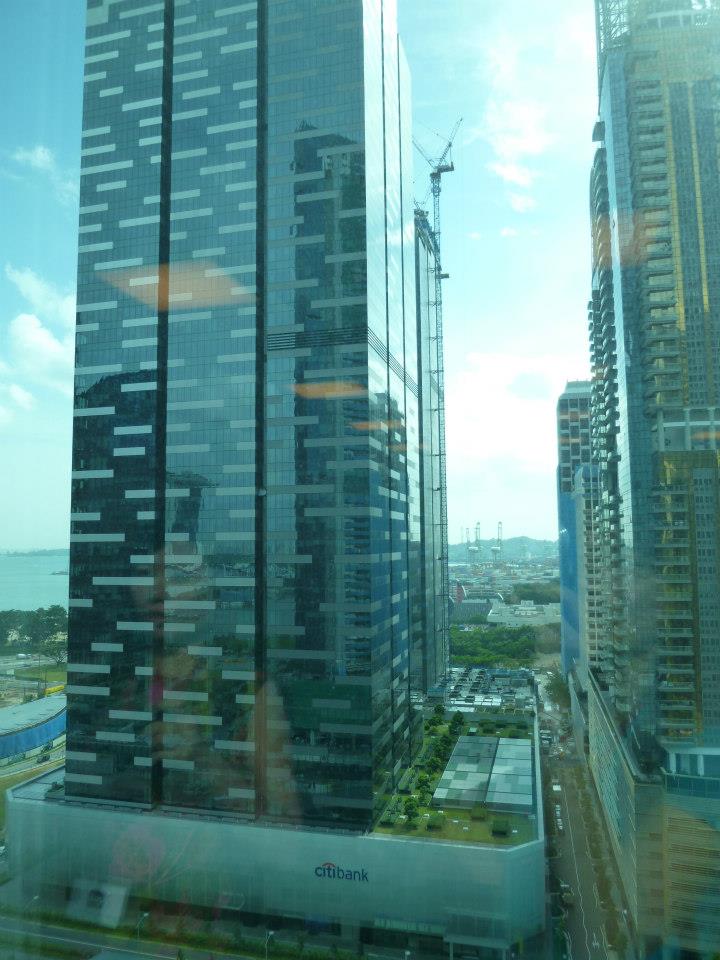
For visitors travelling above the ground, look out for the towering blue skyscrapers with the Standard Chartered Bank sign! You will know that you have reached the Marina Bay Financial Centre when you catch the sights a sculpture of two water buffaloes by British sculptor, Dame Elisabeth Frink.


Water Buffaloes. By Dame Elisabeth Frink.

While I was waiting to purchase tickets, it came to my attention that this event is largely volunteer-driven. I felt appreciative of their efforts to make OH! Open House possible. Thanks to the team of people who have made OH! Open House possible!


Before the start of the tour, participants were asked to wait at an auditorium. I did not quite like the experience of waiting in the auditorium as it just felt like a space that is corporate and impersonal. Can we really find happiness in such spaces?

Without spoiling the surprise elements and the excitement for potential visitors, I shall reveal what had caught my interest and/or attention at this year's OH! Open House.


Joy Oh's work at the OH! Open House reminded me of one of Gosia Wlodarczak's works at the Singapore Biennale 2011. Joy Oh's drawings on the window panels seem to be interacting with the spaces in the DBS' Super Social Hub as well as the bigger world outside the Marina Bay Financial Centre's building. Maybe there is joy found in interacting constantly with our internal and external world.

The surprise performance created by Spell#7 brought a sense of nostalgia and heart-warming spirit to the otherwise cold and impersonal spaces of the DBS' Super Social Hub. What is a social hub without people who are feeling alive and in love with the present moment? When the performance caught you by surprise, be present and experience the moment! Happiness can be found in the present moment!

Nguan's works. OH! Open House 2013.

One part of the tour brought us underground to the Marina Bay Link Mall. I wonder whether it was the intentions of the curators to make us participants be aware of the stark contrast of walking underground and above-the-ground. Walking underground, I felt a sense of being stifled although I was protected from the rain and the sun. The entire experience somehow prepared me to identify deeply with Nguan's works that were exhibited at a part of the Marina Bay Link Mall. Through these works, Nguan seems to be bringing the heartland to the city. Looking at the photographs that were taken at open spaces above-the-ground, I felt a desire to move out of the underground spaces so that I could finally delight myself in the loving rays of the sun. Maybe the spaces that we live our lives in could influence our happiness index?

Frayn Yong's Fragile Structures. 

Sheer delight could be felt when participants saw Frayn Yong's Fragile Structures. This piece of art installation was made out of fine and thin graphite! Maybe a sense of awe in what could be possible could trigger a sense of happiness in us human beings? Our wonderful tour guides shared with us that the artist was exploring the potential of negative spaces through this work.


Evil Empire's performance at OH! Open House was baffling. I have had no clear clue what was going on. The experience felt rather eerie. It did not help that I have yet to read and will still need a lot of help to appreciate Kafka's The Trial which I understand had greatly influenced Evil Empire. If you could understand how this performance could help us find out more about our Happiness Index, please enlighten me.

Marina Bay's Past and Present
During the tour, our guides gave us a quick introduction of the history of Marina Bay. The land at the Marina Bay Financial Centre used to be a part the sea. I tried to imagine how life would have been sailing and fishing out at the sea in those days in the distant past.

Subsequently, after the land reclamation project of the Marina Bay area was completed, for a period of time,  before the skyscrapers were built, the area of Marina Bay was used for various leisure and recreational activities. I vaguely recall that it was a place for kite-flying and a place for barbecued cuisine as well as seafood.

I looked about the present Marina Bay and realized what a transformation this area has went through. Would  the existence of a large financial district that will be larger than Wall Street when it is completed in any way add to our Happiness Index? I do not have the answers.


A visit to Deutsche Bank
I have heard about how some financial institutions acquire their own private art collections. It was a pleasant piece of news to learn that one of the venues of OH! Open House 2013 was a visit to Deutsche Bank. Two representatives from Deutsche Bank warmly welcomed everyone in the tour group. I love their hospitality. It somehow reminded me fondly of my experiences during OH! Open House 2012 and the year before whereby some of the home-owners actually made time to welcome participants to their private spaces.

We had the opportunity to take a look at some of the private art collections of Deutsche Bank during our visit. However, photography of its private art collection is not permitted.


In the meantime, I was happily admiring the view outside the office of Deutsche Bank as well as appreciating Shubigi Rao's Blotting the Ledger. For this work, the artist soaked text books with text and drawing in ink. This is quite a thoughtful piece considering that it is placed in the boardroom of Deutsche Bank.

I was looking out of the window.


My personal favourite
In a legal firm in Far East Finance Building, Tan Peiling's And They Gathered Them Together In Heaps left a positive impression on me with sounds reminding us of a time before the Marina Bay Financial Centre existed. Somehow, I felt it was very therapeutic to be in the space of a not-so-new office experiencing the sound-scape from this work. Happiness could be felt when I listened to the sounds of the ship-horns and the sounds of the waves?


At Google's office
One of the stops was at the office of the company that is associated with one of the most well-known search-engines of our time, Google. Would it be easier if the search for happiness could be made faster with the use of a search-engine?

At Google's office in Singapore, Eeshaun's giantic and colourful abstract paining The Search for Happiness explores the search for happiness, and he concluded that "The search for happiness is inside".  My interpretation is that we have to look within ourselves to find happiness.


My conclusion
I prefer the more lively venues of OH! Open House of the previous years. Somehow, the Marina Bay Financial Centre felt like an impersonal neighbourhood for me. At a first glance, things looked so orderly that they appeared non-spontaneous. Then again, if happiness can be found from within us, maybe it does not matter how the external circumstances were?

Looking back, I will still attend OH! Open House 2013 nevertheless. It is such an interesting local art event and the best way to see it thriving is to support it.

Make your way to the Marina Bay Financial Centre Tower Three these upcoming weekends. For security clearance, please bring along a photo identification card to access the banks.

OH! Open House 2013
5, 6, 12, 13, 19, 20 January 2013
11 a.m. - 5 p.m.
(Last tours leave at 3 p.m.)
DBS Asia Central 
Marina Bay Financial Centre
12 Marina Boulevard, Tower 3, Level 3
Tickets at the door, $20 per person
http://www.ohopenhouse.com


***
You may also like to read:- Preview: OH! Open House 2013: The Happiness Index at Marina Bay, by Gwen Pew, published on TimeOut Singapore.
- OH! Open House Marina Bay: The Happiness Index, by Teoh Yi Chie
- A quick look at OH! Open House Marina Bay by Mayo Martin, video by Sion Touhig, TODAY Online.
- There's art in this concrete jungle if you know where to look by Mayo Martin, TODAY Online
- OH! Open House: The Happiness Index, City Nomads.
- Review: Open House! Marina Bay by Adeline Chia
- http://www.indiegogo.com/ohopenhouse/ (To order a special tour package)


Thursday, January 03, 2013

A tour of Soon Thian Keing


On 9 Dec 2012, I had the pleasure to attend a tour of a Chinese temple, Soon Thian Keing. It was the name of the tour that had attracted me. The name was The Rosetta Stone of Singapore History. Our guide had explained how the name of the tour was coined. My confession is that my ears were losing focus and did not recall what was being said! I could only try to make a good guess that the name of the tour probably suggests that the tablets that were discovered in Soon Thian Keing in 1981 when it was situated at 73 Malabar Street could hold the keys to our understanding of Singapore before the British founding of Singapore (in 1819)?

Soon Thian Keing temple, Singapore.

Furthermore, I learnt that the founding of this temple can be traced to 1812 slightly earlier than the British founding of Singapore. This is a part of the history of Singapore that I have yet to come across in the history text and I was eager to find out more even though I know very limited about Chinese temples in Singapore, Chinese religions and about Soon Thian Keing itself


The tour was organised by Chinatownology. One of the personnel from the temple's management gave us visitors an overview of the history of the temple. I learnt that the name of the Chinese Hokkien temple, Soon Thian Keing, can be literally translated into "Obedience to Heaven". The temple currently sits at 19 Lorong 29 Geylang, Singapore 388070.

Since my ears did not seem to be very attentive that day, I shall not attempt to recall what I have learnt about  Soon Thian Keing in this post. Instead, I shall point interested readers to this webpage,
Chinatownology: Soon Thian Keing: http://www.chinatownology.com/Soon_Thian_Keing.html

The inscriptions on the stone tablets of Soon Thian Keing .
In a nutshell, the inscriptions on the pair of stone tablets that was discovered in Soon Thian Keing in 1981 suggested that the temple was founded as early as 1812, even before Sir Stamford Raffles founded Singapore! Thankfully the temple's management has managed to preserve the tablets.

One of the stone tablets of Soon Thian Keing.

During the tour, I was intrigued by how the seemingly simple tablets could tell a whole lot of history and allow the visitors to trace the history of the temple. The tablets reminded me to appreciate and treasure the material culture around me.

The tour has also piqued my curiosity on the exact location of Malabar Street. I was then reminded of the tour, Hainan Kopi Tales, that I had went for a few years ago. During that tour, it was the first time that I was made aware of a street named Malabar Street. According to Singapore Infopedia, Malabar Street connects Middle Road and Malay Street. I think I would need to search for a map of Singapore perhaps as early as the 1880s.

The divine presence. Soon Thian Keing.

Soon Thian Keing had to relocate from its original location at 73 Malabar Street because in 1984, it was informed that it "stood in the path of Singapore's future SMRT transport system". Subsequently, it was temporarily relocated at 173 Albert Street before it moved to its present site at 19 Lorong 29 Geylang. During the tour, we heard a bit about the resettlement process of the temple from its original location to its current location.


At the temple, I felt a sense of good vibes and peace. My eyes noticed a certificate that was framed and put up on the walls. The certificate read: "Soon Thian Keing, Singapore's First Chinese Temple. The temple was established during the reign of Qing Dynasty's Emperor Jia Qing (1796 - 1821)". This certificate was presented by the Singapore Book of Records to the temple on 22 September 2012 (7th day of the 8th lunar month). It looks like the certificate could be an endorsement that Soon Thian Kieng is the first Chinese temple in Singapore.


The images of lotus found in the temple symbolise blessings.

I still do not know much about this temple. Yet visiting it marks the first step to become more aware of a part of the history of Singapore. I thank Mr Victor Yue for the invite, the temple's management for its hospitality, and Chan for guiding the tour.

***
Soon Thian Keing 
19 Lorong 29 Geylang
Singapore 388070
(view map)

***
Also see:
http://www.chinatownology.com/Soon_Thian_Keing.html
http://www.expatliving.sg/online-magazines/2012/OnlineGuideTo-FoodwalkerTours.pdf (refer to pg 16, by Kevin F. Cox)
Malabar Street, from Bugis Street, 1982: general view (From the Lee Kip Lin Collection), PictureSG

Wednesday, December 26, 2012

A Life of Practice - Kuo Pao Kun: Special Guided Tour with the Curator


Good luck was on my side when despite a rather busy schedule, I could steal some time out to attend a special guided tour with the curator of the exhibition, A Life of Practice - Kuo Pao Kun.

This year marks the 10th anniversary of the passing of Kuo Pao Kun. He was an internationally acclaimed playwright, director and arts activist. He was awarded the Cultural Medallion in 1990 for his contributions to Singapore theatre. While I am not very familiar with Singapore theatre, I felt it was critical to learn more about Kuo Pao Kun as he had contributed significantly to the local theatre scene.

A Life of Practice - Kuo Pao Kun

Weeks before I had attended the special guided tour with the curator, Lynn Lee, I had visited the exhibition on at least two occasions. During my first visit, I browsed through the entire exhibition yet I left lost as I did not know how to make sense of the exhibition, given its depth and breadth. My second visit to the exhibition was spent sitting down to watch the recording of an interview with Kuo Pao Kun's wife, Goh Lay Kuan. As I watched the interview that gave visitors glimpses of Kuo Pao Kun's artistic vision and practices, I knew I had to return to the exhibition yet again to find out more.

When I learnt that there will be a special guided tour to this exhibition with the curator, I instinctively knew it will be in my interest to register for one of the tours. I had managed to register for one of the Mandarin tours.


The special guided tour was very well-delivered. The curator pointed out the important exhibits that were worthy of our attention, which on my own, I had totally overlooked many of these exhibits.

Growing-up years of Kuo Pao Kun
The tour began with an introduction to Kuo Pao Kun. The curator led us to a section of the exhibition which displayed photos and archival materials related to the growing-up years of Kuo Pao Kun. The curator pointed out to all the participants a photograph. On the back of this photograph, Kuo Pao Kun had written a personal message to his father. It revealed to me that even as a teenager, Kuo Pao Kun had an independent mind of his own.

Growing-up years of Kuo Pao Kun.


His Theatrical Education
More intriguing for me was the next section of the exhibition which showcases Kuo Pao Kun's theatrical education at the National Institute of Dramatic Art in Sydney. When I had visited this exhibition on my own, I had completely neglected this section thinking it was just showcasing some papers that I could not seem to understand. Alas! I was wrong! Through the curator, I learnt that one of the artefacts in this section contained notes that Kuo Pao Kun had written down when he directed The Bear by Anton Chekhov. I was impressed by the systematic and diligent way that Kuo Pao Kun had made notes to enhance his learning.


The motivational letters by Kuo Pao Kun
I was most captivated by the letters and greeting cards written by Kuo Pao Kun to his family. These letters and cards were written during the period when Kuo Pao Kun was detained under the Internal Security Act from 1976 - 1980. The sense of optimism and hope in these letters and cards were simply uplifting.

For example, in one of the letters, there was a parting message to his family that I have found very uplifting:
"Even though we're apart, let us work hard together in our respective positions and places; cultivate good habits and better ourselves everyday. When we next meet, we can proudly proclaim to each other, time is not wasted on us, I was better than yesterday!"
The drawings on the greeting cards also drew my attention to Kuo Pao Kun's creativity and talent in sketching.

Poem by Kuo Pao Kun on a greeting card:
"The world does not treat us unkindly or forget us.
In the midst of solitude,
even the maize teaches me generously each day:..."
(English translation by Teo Han Wue and Kwok Kian Woon from http://kuopaokun.com)

Kuo Pao Kun and some of his major plays
The rest of the exhibition was equally engaging. The curator tour gave the participants critical insights on how we can better appreciate this exhibition that discusses the life and the practice of Kuo Pao Kun. 

When we were at the section of the exhibition that focused on the play, The Silly Little Girl and the Funny Old Tree, the curator drew to our attention to the detail that for the first performance of this play, Kuo Pao Kun had engaged Liu Ching-min as one of the directors so as to engage Liu's expertise in the radical theatre methodology of "Poor Theatre".

The Silly Little Girl and the Funny Old Tree.

Liu Ching-Min had trained with Jerzy Grotowski who developed the concept of "Poor Theatre". I was rather intrigued to learn that it was important to Grotowski that the actors "delivered through their bodies and voice without aids...". I had the pleasure to watch excerpts of the recordings of this play, and it somehow made me think of the magnificent rain-tree at the roundabout of the Bukit Brown cemetery which is to make way for the proposed development of a dual four-lane road. May there be a positive ending that is in the highest interest of all concerned somehow.


In this exhibition, there are sections of the gallery that are dedicated to some of Kuo Pao Kun's major works such as Mama Looking For Her Cat, The Coffin is Too Big for the Hole, The Spirits Play and so forth. By the end of this special guided tour by the curator, Lynn Lee, I could finally consider myself to have an appreciation of Kuo Pao Kun's life of practice. He was a dedicated artist to look up to. I could not help but be moved by his passion for and his contributions to theatre art in Singapore.

**
Many thanks to the curator for an excellent guided tour. It has helped me make better sense of this interesting exhibition, and it has deepened my appreciation of Kuo Pao Kun and his practice of the performing art. I strongly recommend that visitors could consider attending one of the guided tours.

The guided tour aside, I highly recommend interested visitors to make multiple visits to this exhibition so as to have the time to browse through the various recordings of the excerpts of the plays that are featured at this exhibition.

Ideas for the busy visitors
If visitors has only half-an-hour to spare, I would strongly recommend that they watch the interview of Goh Lay Kuan as well as browse through the letters by Kuo Pao Kun that were displayed under the section, Four Years and Seven Months of Solitude.

Interview of Goh Lay Kuan which last about 30 minutes.

**
Special Guided Tour with Curator
Tours in Mandarin: 15 Dec 2012 (Sat) and 19 Jan 2013 (Sat). 3 p.m. (60 mins) 
Tours in English: 12 Jan 2013 (Sat) and 16  Feb 2013 (Sat). 3 p.m. (60 mins) 

Venue: Exhibition Gallery 2
Free admission with exhibition admission of $5

For more details, please visit: http://www.nationalmuseum.sg